
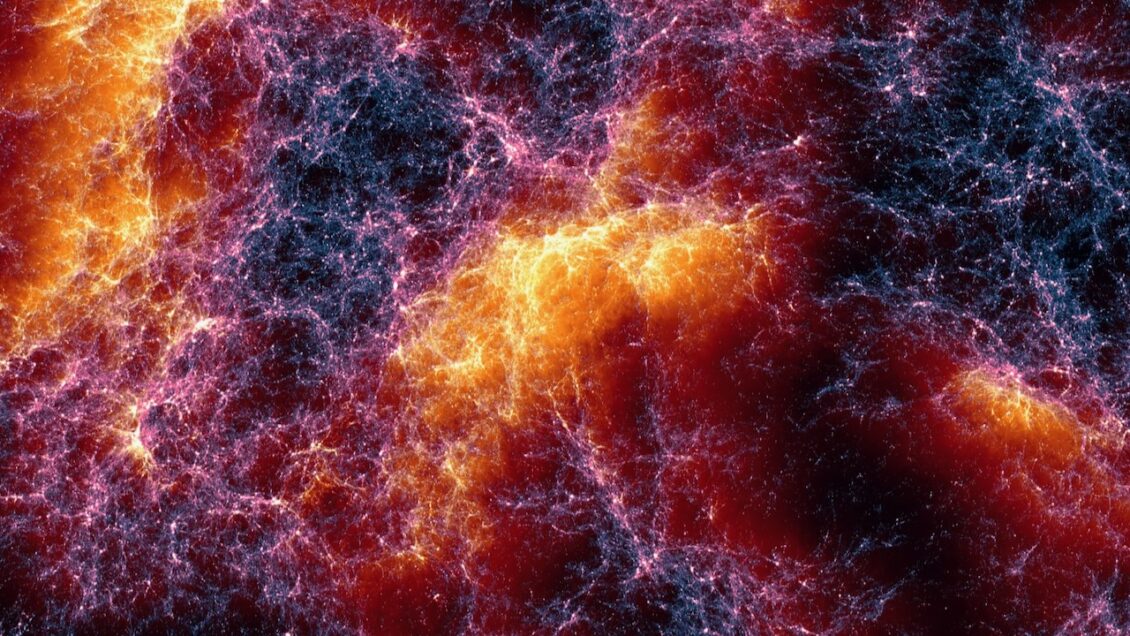
A new simulation called Lumina recreates the universe’s first 2 billion years with unprecedented detail, helping astronomers interpret observations from the James Webb and Nancy Roman space telescopes. It is a powerful example of how computational models can make the invisible history of the cosmos visible and testable.
How did the first galaxies emerge from a universe dominated by gas, dark matter and radiation? A new simulation developed by researchers at the Center for Astrophysics | Harvard & Smithsonian offers one of the most detailed answers yet. Called Lumina, the model recreates the first 2 billion years of cosmic history, tracing how ordinary matter, dark matter and radiation interacted to form stars, galaxies and the vast structures that connect them.
Lumina is described as the largest cosmological radiation-hydrodynamics simulation ever created. It covers a volume more than 100 times larger than comparable previous simulations and models a region of space roughly 1.5 billion light-years across: a scale comparable to what today’s most powerful telescopes can observe.
The simulation arrives at a particularly significant moment for observational astronomy. The James Webb Space Telescope and the Nancy Grace Roman Space Telescope are revealing the early universe in extraordinary detail. Models such as Lumina translate physical theories into predictions that can be compared with telescope data, helping researchers assess whether current understanding of cosmic evolution remains valid or needs to be revised.
One of Lumina’s most important achievements is its ability to follow helium reionisation as it unfolded across an enormous cosmic volume. This process describes how helium atoms were transformed by intense radiation into their modern form, influencing the evolution of the intergalactic gas from which galaxies continue to form. For the first time, researchers can observe this transformation while also resolving the galaxies and luminous objects that drove it.
Creating such a detailed model required exceptional computational resources: more than 15000 graphics processing units running on Frontier, on the world’s fastest supercomputers, located at Oak Ridge National Laboratory. The result is a visualisation of the past and a research platform designed to test new ideas about galaxy formation, the movement of gas between galaxies and the influence of radiation on cosmic evolution.
For VIS, Lumina offers a compelling example of the kind of science that can be transformed into immersive storytelling. Simulations translate complex physical processes into dynamic, navigable forms and virtual reality can then invite audiences to move through those forms and experience cosmic history from within. In this sense, projects like Lumina advance research while also creating new opportunities to communicate the universe’s earliest chapters to wider publics.
The study has been published in Monthly Notices of the Royal Astronomical Society.
Cover image: © 2026 Lumina Collaboration